
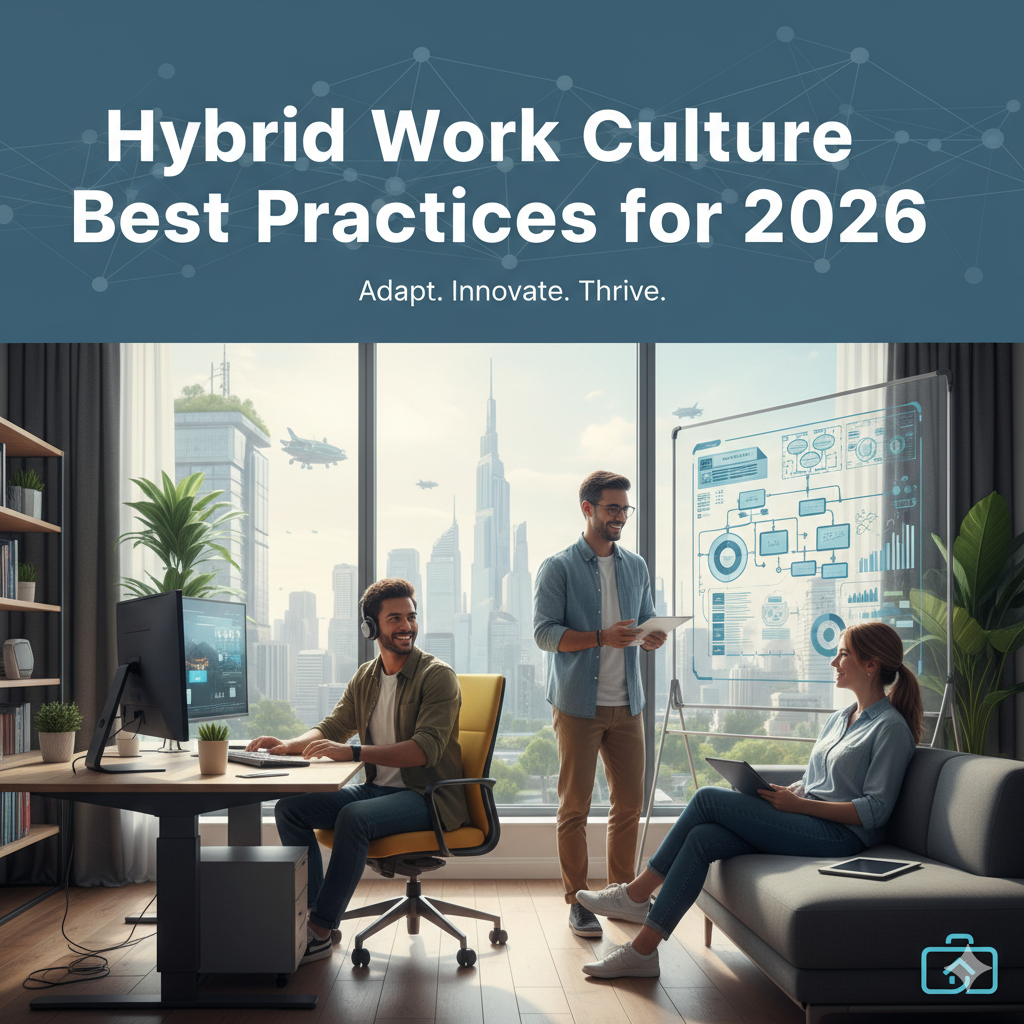
Post the pandemic, as everything has regained its normalcy, few companies are still working with the hybrid work model. While the inboxes of some employees are awash with return to office incentives, some companies have recognised the benefits and potential of letting employees work from home. Let’s read the best practices for staying productive and adaptable in the hybrid work culture in 2026 without burning out.
So, the question centres, did the pandemic temporarily breach the everyday routines, or did it really give us all truly a new way of life? How can companies still afford to let employees work in a hybrid model?
Nicholas Bloom from the Stanford University performed a large study and found that the employees who worked from home for two days in a week, showed same productivity levels as their in-office peers. Although, the most important stat from this study was that the number of resignations fell 33% among the hybrid workers. Now, this number does tell us how work-life balance affects a person’s working and the mental state.
Another study showed that with a hybrid work module, people saved about 5-10 hours/week of commute time, resulting in approximately 30% satisfaction with their employers. In an increasingly busy lifestyle, where time really translates to money, getting this time on your hands means not only good physical health, but also better happiness index.
As technology improves, employees are seeking more freedom and connection, and companies are now looking at the hybrid work model more as a strategic need than just an added benefit to keep and attract talent.
In this article, let us discuss how organisations need to adapt new hybrid work culture best practices for 2026 that focus on flexibility, equity, and performance equally.
The Rise and Evolution of Hybrid Work Culture
By 2026, the hybrid work module is supposed to mature from a reactive stop-gap to a strategic organisational choice. Gartner’s 2019 report showed that only 8-10% companies opted for hybrid work model, while the recent ETHR World report shows it has now jumped to 53% globally. This hybrid work culture has also paved way for digitization across organisations, as an agile technology infrastructure is the most important aspect for this model.
Hybrid Work Culture Best Practices for 2026
As we step into the new year of possibilities and opportunities, companies are closely looking to improve their hybrid work culture best practices. And they have concluded – a successful hybrid work model is the one that goes beyond mere policies, it is more about building ecosystems of trust, purpose and adaptability. Building a truly sustainable hybrid work culture, you need to blend flexibility with structure, technology with empathy, and autonomy with accountability.
The following hybrid work culture best practices 2026 guide leaders and teams in creating workplaces that are both resilient and human-centered.
1. Clarity and Purpose: Building Hybrid with Intent
For a thriving hybrid work culture, you need to set intentions. Far too often, it is observed that organisations opt for this work model without clarifying the ‘why’ and how’ behind it. So, the employees don’t have a clear idea on why this flexible work model exists, or how exactly connects to the business goals. A clear purpose helps align the teams around shared expectations. Leaders further also shoulder the responsibility of defining the vision for their hybrid model.
For instance, defining which layer of the organisation works remotely, planning events for collaboration in person, and most importantly, what the success metrics look like. Setting these transparent policies, and ensuring clear continuous communication about these will help you build trust and accountability. On the employees’ side, they also understand how their individual contributions support the collective outcomes.
2. Technology as the Foundation
Technology is the backbone of hybrid work. An agile technology network will allow your employees to seamlessly collaborate, create and communicate, regardless of the location. Be it unified communication platforms or the AI-enabled workflow tools, technology helps drive connection and productivity in companies with an aggressive hybrid work culture. Adding to its security benefits, this digital adoption also helps companies predict new trends and incorporate them quickly and stay ahead of the curve.
3. Redefining Leadership and Management
It isn’t a surprise that leadership and management in these changing landscapes need an upgrade too. Traditional leadership was deeply rooted in supervision and presence, but with hybrid work culture, it has now evolved to focus more on the outcomes, empathy, and empowerment. Successful leaders in a hybrid workplace have these three distinct traits –
- Set clear intentions
- Trust teams to deliver results
- No micromanagement
It surely is a task to keep a dispersed team aligned, and building trust and emotional intelligence, and prioritizing inclusivity keeps the team intact, bringing out the best in everyone. More importantly, leaders model the flexibility they advocate, showing that hybrid work is a shared cultural value, not a privilege.
4. Employee Well-being and Work-Life Balance
Sustaining this environment of hybrid work culture, people at the epicentre make the most difference. Flexible working blurs the lines between home and office, and in some cases can heighten burnout if not managed properly. So, the flexible working, which is supposed to come with a security and satisfaction, turns out to be chaotic and less preferred. To ensure this does not happen, employers must invest in mental health support, ergonomic resources, and programs that encourage boundaries.
A culture that normalizes rest and recovery enhances engagement, retention, and ultimately productivity in hybrid work environments. In 2026, well-being is recognized not as a perk but as a pillar of performance.
5. Continuous Learning and Feedback Loops
Hybrid work is evolving, and so must the people who make it possible. Organizations committed to the future of hybrid work invest in continuous learning—digital literacy, collaboration skills, and adaptive leadership. Regular feedback loops through employee surveys and performance analytics help leaders refine policies in real time.
Data-driven insights reveal what’s working, where friction exists, and how to improve both engagement and output. Encouraging experimentation and agility ensures that hybrid culture stays dynamic rather than static. Ultimately, a learning-oriented organization will not just survive the next wave of workplace change—it will lead it.
The Future of Hybrid Work
As we look ahead, the future of hybrid work will be defined by intelligence, flexibility, and a deep human focus. Between 2026 and 2030, workplaces will evolve from simply managing hybrid schedules to orchestrating AI-driven ecosystems that optimize collaboration, productivity, and employee well-being. AI workplace analytics will move beyond measuring attendance or engagement—they will predict burnout, recommend optimal meeting times across time zones, and personalize hybrid schedules to match individual work rhythms.
At the same time, smart offices will redefine the in-person experience. From adaptive lighting and temperature controls to space utilization data and AR-powered collaboration hubs, office spaces will become responsive environments designed for creativity and connection. Many organizations will also experiment with 4-day hybrid weeks, blending productivity with purpose and giving employees the flexibility to achieve more in less time.
The global workforce will continue to decentralize, powered by digital-first, borderless teams. Collaboration platforms will act as digital headquarters, seamlessly connecting talent across continents. Success will hinge on adaptability—how quickly leaders can evolve policies, tools, and mindsets to keep pace with changing expectations.
Ultimately, the future of hybrid work won’t be about balancing remote and office—it will be about building cultures that transcend location. Innovation, inclusivity, and trust will shape this next chapter, where work becomes more fluid, human-centric, and performance-driven. Companies that embrace this evolution will not just retain talent—they’ll lead the transformation of how the world works.